
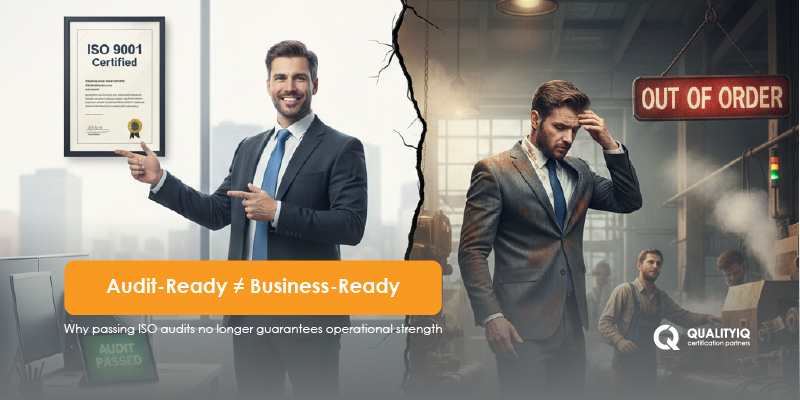
Quality Systems That Pass Audits but Fail the Business
Many ISO-certified organisations believe they are operating with robust quality systems. After all, the certificates are current, audits are passed, and nonconformances are minimal.
Yet beneath the surface, a different reality often exists.
Processes are followed selectively. Data is collected but rarely used. Risk registers are maintained for compliance, not insight. Leaders sense something isn’t working but struggle to pinpoint where or why.
The core problem isn’t noncompliance. It’s the growing gap between being audit-ready and being business-ready.
When quality systems exist primarily to satisfy audits, they lose their original purpose: enabling control, consistency, and confident decision-making.
Operational Fragility Hiding Behind Certification
This gap has real consequences.
Organisations that are audit-ready but not business-ready experience:
- Recurring issues disguised as “new problems”
- Inconsistent performance across teams and sites
- Over-reliance on key individuals instead of systems
- Leadership decisions driven by intuition rather than evidence
Over time, quality becomes seen as administrative overhead, something to maintain, not something to leverage.
The result is operational fragility: systems that appear stable until pressure is applied. Growth, change, or disruption quickly expose weaknesses that audits never flagged.
Passing audits may preserve certification but it does not protect performance.
Rebuilding Quality Systems Around How the Business Actually Works
A business-ready quality system is designed for use, not inspection.
This means shifting focus from documentation to behaviour, from compliance to capability, and from audit cycles to operational rhythm.
Business-ready systems:
- Embed quality into everyday decision-making
- Turn audit findings into improvement opportunities
- Align KPIs with strategic and operational priorities
- Create consistency without stifling flexibility
Most importantly, they give leaders confidence, confidence that the system will hold under pressure, not just during audits.
When quality systems reflect how the business truly operates, audit success becomes a by-product, not the objective.
Turning ISO Systems into Strategic Infrastructure
QiQ works with organisations that are done “maintaining ISO” and ready to extract real value from it.
Our approach goes beyond certification support. We help businesses:
- Diagnose the gap between audit readiness and operational reality
- Redesign quality systems to support leadership, not paperwork
- Translate audit outcomes into measurable performance improvements
- Build systems that scale with the organisation, not against it
We don’t believe quality should live in binders, folders, or audit calendars.
At QiQ, quality systems are treated as strategic infrastructure, the foundation that enables consistency, accountability, and long-term resilience.
Because when quality systems work for the business, audits stop being stressful events—and start becoming confirmations of strength.