
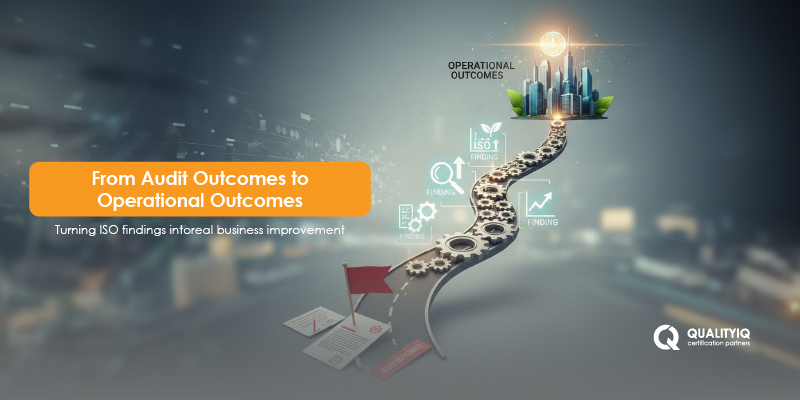
For many organisations, ISO audits mark the end of a cycle.
Findings are issued. Corrective actions are logged. Evidence is submitted. The certificate is protected. Then the business moves on until the next audit.
But organisations that consistently perform, scale, and adapt treat audits very differently. For them, audits are not administrative events. They are operational signals.
The difference lies in whether audit outcomes are used to close findings or to change how the business works.
Reframing the Role of Audits
ISO audits are often misunderstood.
They are seen as tests of documentation rather than assessments of system behaviour. As a result, many organisations prepare for audits by tidying up procedures, updating registers, and ensuring records are complete without examining whether the system actually supports daily operations.
In reality, audits are one of the few structured moments where organisations step back and observe how work is truly done.
When approached correctly, audits reveal:
- Where processes break down under pressure
- Where controls exist only on paper
- Where risks are acknowledged but unmanaged
- Where performance relies on individuals rather than systems
These insights are far more valuable than the audit result itself.
Why Audit Findings Rarely Change Behaviour
Despite this potential, audit findings often fail to drive meaningful change.
Corrective actions are commonly:
- Assigned too low in the organisation
- Focused on documentation fixes
- Closed without verifying behavioural change
- Treated as isolated issues rather than system signals
Root cause analysis becomes a formality. Actions are implemented to satisfy the auditor, not to improve operations.
Without leadership ownership and operational integration, findings are resolved administratively while the underlying issues persist. Over time, the same problems reappear under different labels.
What Business-Ready Organisations Do Differently
Organisations with business-ready quality systems respond to audit outcomes in fundamentally different ways.
They ask better questions:
- What does this finding tell us about how our system actually works?
- Where else might this issue exist?
- What operational risk does this expose?
Audit findings are elevated beyond the quality function and discussed in leadership forums. Ownership sits with process owners, not compliance coordinators.
Corrective actions are:
- Linked to operational KPIs
- Integrated into planning and review cycles
- Tracked for effectiveness, not just closure
In these organisations, audits become catalysts for improvement, not interruptions to “real work”.
Turning Audit Cycles into Improvement Cycles
To move from audit outcomes to operational outcomes, organisations must embed audits into their business rhythm.
This means:
- Using management reviews as decision-making forums, not reporting rituals
- Connecting audit results to risk, performance, and strategy discussions
- Prioritising actions based on business impact, not audit severity
- Measuring whether changes actually reduce issues, rework, or variation
When audit insights flow into leadership decisions, the quality system becomes a living mechanism, one that evolves with the business.
The Payoff: Confidence, Consistency, and Control
Organisations that treat audits as operational tools experience fewer surprises.
They respond to issues earlier. Performance becomes more predictable. Decisions are supported by evidence rather than instinct. Growth exposes capability, not fragility.
Most importantly, leaders regain confidence, not just in their certification, but in the systems that underpin the business.
Because the real value of an audit is not the report at the end.
It’s what the organisation chooses to do with it.