
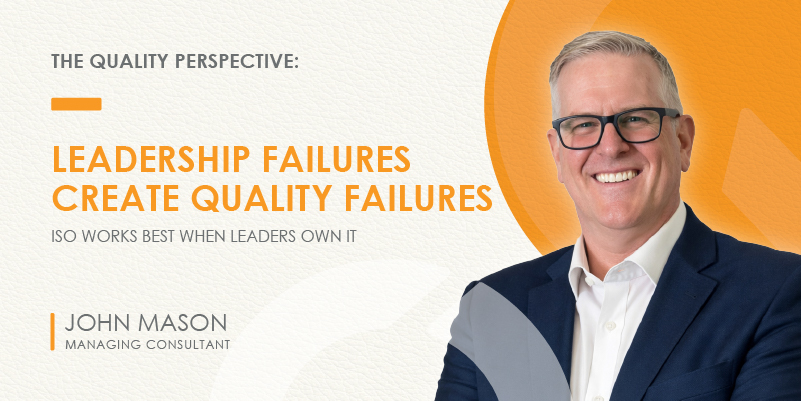
With more than 34 years of experience in ISO systems, governance, and operational excellence, John Mason shares practical leadership insights on why quality systems succeed or fail. From executive accountability to scalable governance and measurable performance, his perspective highlights how organisations can transform ISO from a compliance obligation into a strategic business advantage.
In your experience, what are the most common mistakes senior leaders make when implementing ISO systems, and how do these impact long-term business performance?
- Delegating ISO ownership to “Quality” without authority or budget. When accountability is pushed down without decision rights, implementation stalls, cross-functional adoption is weak, and the system becomes performative rather than operational.
- Insufficient ELT consensus and visible commitment. Misalignment at executive level leads to inconsistent priorities, limited participation in governance activities, and poor role-modelling—reducing credibility and compliance over time.
- Designing for perfection (“best practice”) instead of fit-for-purpose maturity. Over-engineered processes create bureaucracy, slow decision-making, and reduce agility. A benchmark-and-improve approach supports sustained adoption and incremental performance gains.
How can executives move beyond treating ISO certification as a compliance exercise and instead leverage it as a strategic tool for operational excellence?
- Make ISO system performance measurable in financial terms. Treat ISO activities and outcomes as visible line items and drivers in planning (e.g., cost to obtain/maintain, cost to sell, margin impact, rework and waste, and implications for goodwill and customer retention).
- Embed the management system into business planning. Integrate system objectives into the business plan, operational objectives, and significant programs—then resource them appropriately (people, time, tooling, and governance capacity).
- Use measurement to protect strategic intent. If outcomes cannot be measured, the system tends to revert to compliance behaviour rather than enabling operational excellence.
With more than 34 years in the field, what practical steps should leadership teams take to ensure their quality systems remain effective, scalable, and aligned with business growth?
- Maintain strong operating rhythms (“the big three”). Consistent management reviews, internal audits, and improvement management create a closed-loop system that adapts as the organisation grows.
- Increase workflow oversight through risk-based control points. Thoughtful go/no-go authorisations, checkpoints, and controls across the end-to-end workflow strengthen effectiveness and support scaling.
- Protect agility when selecting software platforms. Be cautious of expensive, overly bespoke tools that reduce flexibility; agility is a core feature of a high-performing ISO system.
Business Implications
- Operational performance: Fit-for-purpose processes and strong governance reduce variation, rework, and operational risk while improving consistency.
- Financial performance: Measuring system costs and benefits enables informed investment decisions and connects ISO to margin, cost of quality, and customer value.
- Scalability: Risk-based checkpoints and disciplined improvement cycles enable growth without loss of control.
- Culture and accountability: Visible ELT ownership accelerates adoption and makes the system “how we run the business,” not an external requirement.
Recommendations
- Assign executive ownership with authority. Nominate an ELT sponsor and define decision rights, budget, and accountabilities across functions.
- Run the governance cadence. Standardise management reviews, internal audits, and improvement management with clear agendas, actions, owners, and due dates.
- Benchmark current state and prioritise incremental improvement. Avoid over-design; focus on the highest-risk and highest-value process improvements first.
- Translate ISO into business metrics. Establish a measurement approach that links system activities to cost, margin, customer outcomes, and risk reduction.
- Design scalable controls. Implement risk-based go/no-go checkpoints and authorisations at critical stages across key workflows.
- Select tools that preserve agility. Prefer configurable platforms and avoid unnecessary customisation that locks in rigid workflows.