Skip to content
1 300 899 443
Get An Estimate

Why Smart Organisations Are Rethinking ISO in 2026

Across industries, organisations are beginning to ask a new question about ISO standards:

Are we using them merely to stay compliant, or to become more competitive?

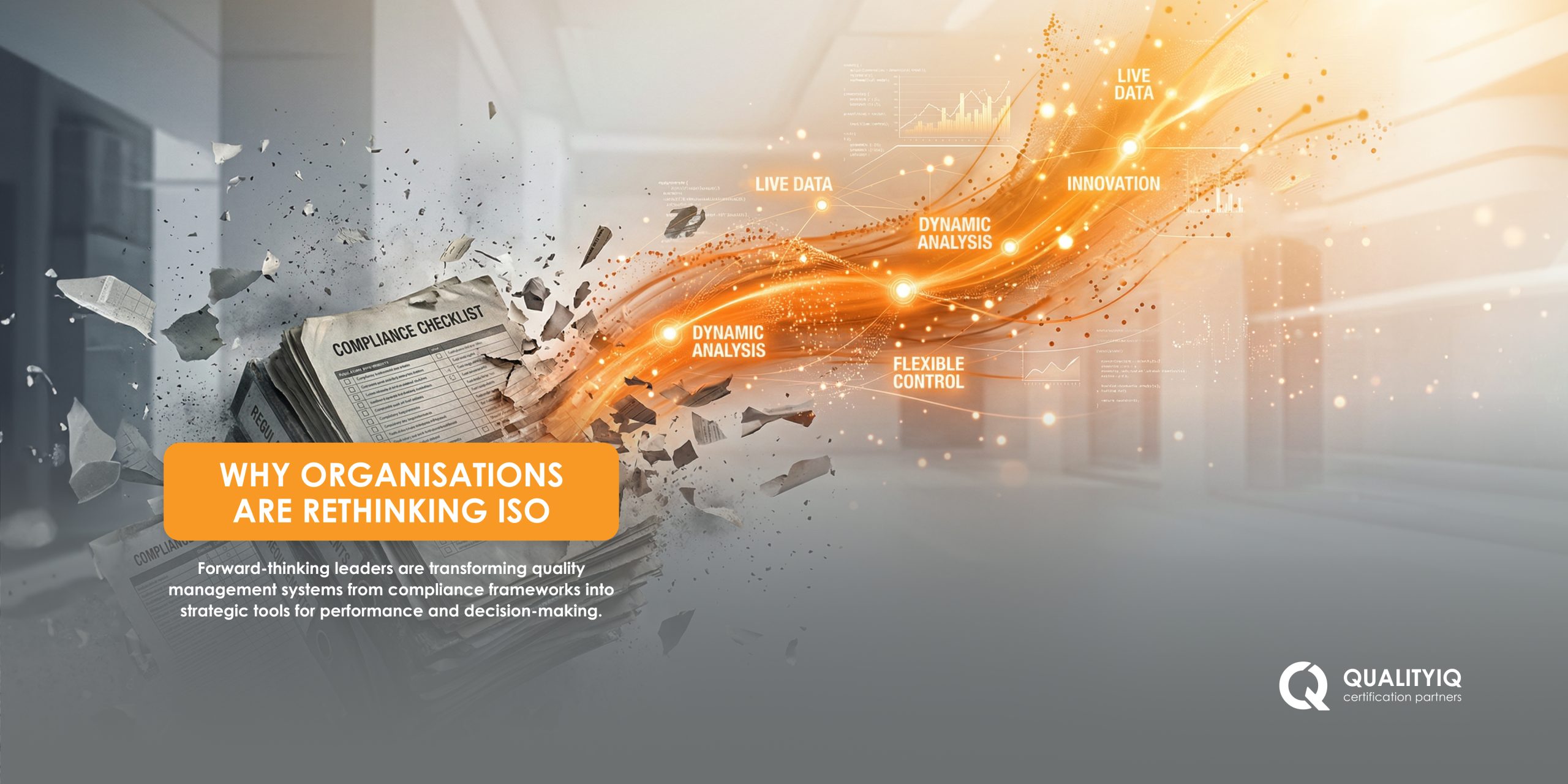
For years, many businesses treated ISO certification as a necessary administrative exercise. Documentation was produced, audits were passed, and certificates were displayed. Yet beyond satisfying requirements, the systems themselves often delivered little strategic value.

That mindset is now changing.

Leading organisations are discovering that when quality management systems are properly embedded into leadership and operational decision-making, they can become powerful tools for clarity, alignment, and performance improvement.

Rather than viewing ISO frameworks as static compliance structures, forward-thinking executives are using them to support:

  • Stronger operational visibility
  • Better risk identification and mitigation
  • More disciplined strategic execution
  • Clearer accountability across teams

This shift reflects a broader trend in modern management: systems that once supported compliance are now expected to drive performance.

The organisations gaining the most value from ISO today are those that move beyond documentation and certification, and focus instead on system maturity.

System maturity means using the framework to guide leadership decisions, structure internal processes, and align teams around measurable objectives.

In other words, the question is no longer:

"Are we compliant?"

It is increasingly becoming:

"Is our system helping us run the organisation better?"

As competition intensifies and complexity grows, organisations that leverage their quality systems strategically will gain a clear advantage over those that treat them purely as administrative requirements.

And that distinction may define the next generation of operational leadership.
GO BACK

Contact Us

Oberon NSW Pty Limited t/as QualityIQ
ABN: 45 055 307 572

Phone Number
1300 899 443

Email
info@qualityiq.com.au

Office Address
S2/L29 259 George Street
Sydney NSW 2000 Australia

Postal Address
PO Box 6238 Norwest
NSW 2153 Australia

By submitting this question your email address will be added to our communication list. This list is not shared with anyone else. You will receive our monthly e-news so that we stay in touch. You can unsubscribe at any time if the information we provide is not helpful.

QualityIQ

  • Why Us
  • Our Team
  • Guarantee
  • Portfolio
  • Testimonials

ISO  9001

  • Certifications Process
  • Our Proven 5 Step Framework
  • Our Unique Approach
  • Your Seamless Quality Support
  • Your Unified Quality System

Resources

  • Case Studies
  • Pricing
  • Resources
  • Articles & News
  • Contact Us
  • Get An Estimate

Subscribe to our Newsletter

Follow Us

Facebook Linkedin
© Copyright QualityIQ Certifications Partners 2026
| Privacy Policy

Get an Estimate

More about us and what we need
By submitting this request your email address will be added to our communication list. This list is not shared with anyone else. You will receive our monthly e-news so that we stay in touch. You can unsubscribe at any time if the information we provide is not helpful.
  • Home
  • About Us
    • Why Us
    • Our Team
    • Guarantee
    • Testimonials
    • Clients
  • Services
    • Certification Process
    • Our Proven 5 Step Framework​
    • Our Unique Approach
    • Your Seamless Quality Support
    • Your Unified Quality System
  • Solutions
  • Industries
    • Manufacturing
    • Inventory Management
    • Professional Services
    • Logistics
  • Case Studies
  • Pricing
  • Resources
  • Articles & News
  • Contact Us
QualityIQ Website © 2024 All Rights Reserved
Facebook Linkedin

Across industries, organisations are beginning to ask a new question about ISO standards:

Are we using them merely to stay compliant, or to become more competitive?

For years, many businesses treated ISO certification as a necessary administrative exercise. Documentation was produced, audits were passed, and certificates were displayed. Yet beyond satisfying requirements, the systems themselves often delivered little strategic value.

That mindset is now changing.

Leading organisations are discovering that when quality management systems are properly embedded into leadership and operational decision-making, they can become powerful tools for clarity, alignment, and performance improvement.

Rather than viewing ISO frameworks as static compliance structures, forward-thinking executives are using them to support:

  • Stronger operational visibility
  • Better risk identification and mitigation
  • More disciplined strategic execution
  • Clearer accountability across teams

This shift reflects a broader trend in modern management: systems that once supported compliance are now expected to drive performance.

The organisations gaining the most value from ISO today are those that move beyond documentation and certification, and focus instead on system maturity.

System maturity means using the framework to guide leadership decisions, structure internal processes, and align teams around measurable objectives.

In other words, the question is no longer:

“Are we compliant?”

It is increasingly becoming:

“Is our system helping us run the organisation better?”

As competition intensifies and complexity grows, organisations that leverage their quality systems strategically will gain a clear advantage over those that treat them purely as administrative requirements.

And that distinction may define the next generation of operational leadership.

Why Smart Organisations Are Rethinking ISO in 2026

Why Smart Organisations Are Rethinking ISO in 2026

Across industries, organisations are beginning to ask a new question about ISO standards:

Are we using them merely to stay compliant, or to become more competitive?

For years, many businesses treated ISO certification as a necessary administrative exercise. Documentation was produced, audits were passed, and certificates were displayed. Yet beyond satisfying requirements, the systems themselves often delivered little strategic value.

That mindset is now changing.

Leading organisations are discovering that when quality management systems are properly embedded into leadership and operational decision-making, they can become powerful tools for clarity, alignment, and performance improvement.

Rather than viewing ISO frameworks as static compliance structures, forward-thinking executives are using them to support:

  • Stronger operational visibility
  • Better risk identification and mitigation
  • More disciplined strategic execution
  • Clearer accountability across teams

This shift reflects a broader trend in modern management: systems that once supported compliance are now expected to drive performance.

The organisations gaining the most value from ISO today are those that move beyond documentation and certification, and focus instead on system maturity.

System maturity means using the framework to guide leadership decisions, structure internal processes, and align teams around measurable objectives.

In other words, the question is no longer:

“Are we compliant?”

It is increasingly becoming:

“Is our system helping us run the organisation better?”

As competition intensifies and complexity grows, organisations that leverage their quality systems strategically will gain a clear advantage over those that treat them purely as administrative requirements.

And that distinction may define the next generation of operational leadership.